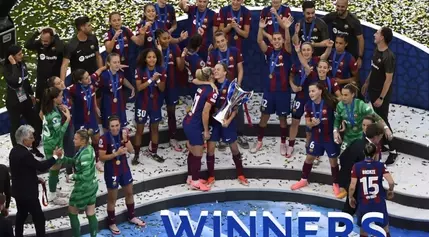
When leading figures from the European game gathered in Lausanne, Switzerland on Monday for the Euro 2025 draw, an exciting announcement was made. The prize money for this tournament is set to more than double compared to the previous edition. With 16 teams participating, including world champions Spain, holders England, and first-time qualifiers Wales, a total of €41million (£34m, m) will be shared. This significant increase is set to have a profound impact on the women's football landscape.
Unprecedented Prize Boost for Euro 2025
Explaining the Prize-Money Increase
In the headline act, UEFA's executive committee, responsible for overseeing the organization's decision-making processes, approved a record €41m prize-money pot for Euro 2025. This allocation represents a remarkable 156 per cent increase from 2022, when it was €16m, and more than five times the amount paid out for the 2017 tournament, which was €8m. While the women's Euros prize money has seen exponential growth, it still lags behind the men's competition. Euro 2024 had a total prize fund of €331m, from overall revenue of about €2.4billion. However, this increase is a significant step in the right direction.UEFA's distribution of the prize money is particularly interesting. National associations participating in Euro 2022 received a €600,000 participation fee, but this has now increased to €1.8m for Euro 2025, accounting for 70 per cent of the overall allocated prize money. This approach shows UEFA's desire to reward all member associations that qualify. Successful teams will also receive additional remuneration, in line with UEFA's new women's football strategy, Unstoppable. The Euros was expanded to 16 teams in 2017, opening up opportunities for smaller footballing nations. Wales and Poland will make their debuts in 2025.In the group stages, a draw will earn €50,000, while a win will accrue €100,000. There are staggered bonuses for each knockout stage. The winner of Euro 2025 could earn a maximum of €5.1m if they win all three group-stage matches. In Euro 2022, winners England received €2.085m in total prize money. "It's huge and a really important message from UEFA in terms of how we're seeing the game grow and evolve," said the Football Association's women's technical director Kay Cossington. "It gives us the ability to provide more of a legacy of the game as well. Of course, it goes into the planning and preparation and to pay for the tournament itself, but also if we can utilize that investment to go in any other parts of the game, we want to keep growing and evolving the base. The stronger the roots of the game, the more opportunity we've got to excel at the top end."Why Player Prize Money is Being Mandated for the First Time
The increase in prize money comes with an obligation for participating national associations to allocate between 30 per cent and 40 per cent of the total distributions received to its players. This is the first such obligation for European women's competitions and recognizes the importance of players to tournament success. Some women's football associations have previously withheld money from their players, as was the case following the 2023 World Cup. This allocation also aims to bring parity for players across Europe. Players who are teammates at one club and compete at a major tournament have discovered that they are afforded different percentages of prize money depending on the nation they play for, which can negatively affect player morale.Increased Compensation for Clubs
European clubs that release players for major tournaments will be compensated at a daily rate of €657 per player due to an increase in club benefits payments to €6m. This sum is an increase from €4.5m in 2022 and represents women's football's highest-paid club benefits programme. The increase is expected to encourage better collaboration between club and country. The release of players from club duties has been a point of contention in recent years, with discussions around rest and recovery continuing. Before the 2023 World Cup, England manager Sarina Wiegman was caught in a club-country tussle over the release of players for pre-tournament preparations.Clubs will be afforded payments based on 10 preparation days, the total number of days a player participated in the tournament, plus one additional travel day. A club will make a minimum of €13,140 for a player whose national team is eliminated after the group stage. The maximum amount will be €24,309 for a player from a team that was in Group A and reached the final. The increase in payments to clubs by UEFA is hoped to encourage better dialogue between clubs. However, if an association wants to request players earlier than the 10-day preparatory period, they will not have access to the €6m.Europa Women's Cup and a New Distribution Model
UEFA's new second-tier club competition finally has a name: the Europa Women's Cup. The competition, which will launch from next season and be a two-legged knockout competition, is a step in the right direction as UEFA attempts to address issues of competitive balance and jeopardy in its cups. Its introduction provides more opportunity for teams to compete in Europe and offers an incentive to clubs that may have given up on qualifying for the Champions League spots due to the dominance of stronger teams in their league. The return for clubs that do qualify for the Europa Cup and compete will, theoretically, help narrow competitive gaps in domestic leagues.The launch of the Europa Cup coincides with the rolling out of a new format for the Champions League, which will adopt an 18-team league phase similar to the men's competition. Both changes will be supported by amendments to the financial distribution model, which is funded mostly by the full centralization of media and sponsorship rights for women's European competitions, starting this season. This is a major development, as revenue is set to increase 122 per cent compared to previous cycles, according to UEFA, and is seen as a big step towards the women's game being self-sustaining.Revenue will be distributed not only to clubs participating in the competitions but also to those who fail to get out of the qualifying stages and even non-participating clubs. From 2025 to 2027, clubs participating from the league phase of the Champions League onwards will benefit from a total of €18.2m (increasing to €24.1m from 2027 to 2030). Teams eliminated in the qualifying rounds will benefit from an increased pot of €7.7m (increasing to €9.1m from 2027–2030). The pot for clubs competing in the Europa Cup will amount to €5.6m (increased to €6.2m). Non-participating clubs will benefit from a share of €6.2m (increased to €7.3m from 2027–2030).While more work remains to be done, particularly in putting women into higher decision-making positions across the governing body, these announcements represent significant steps in the right direction for a game that has, for decades, been starved of support.New








1.3K
52
24
Entertainment



15K
1.3K
539
Lifestyle

48.4K
1.5K
609
Lifestyle

21.2K
1.3K
355
Lifestyle

38.4K
3.1K
491
Lifestyle

4.6K
136
24
Lifestyle
18.3K
549
87
Lifestyle